Introduction
The Office of the Correctional Investigator is pleased to submit to Parliament its Annual Report on the administration of the Access to Information Act (ATIA) for the fiscal year commencing on April 1, 2024, and ending March 31, 2025. This report is submitted in accordance with section 94 of the Act. This report is tabled in Parliament by the Minister of Public Safety.
The Access to Information Act took effect on July 1, 1983. The ATIA gives Canadian citizens, permanent residents and any person and corporation present in Canada a right of access to information contained in government records, subject to certain specific and limited exceptions.
Our Mandate
The Office of the Correctional Investigator is mandated by Part III of the Corrections and Conditional Release Act as an Ombudsman for federal offenders. The primary function of the Office is to investigate and bring resolution to individual offender complaints. The Office also has a responsibility to review and make recommendations on the Correctional Service’s policies and procedures to ensure that systemic areas of concern are identified and appropriately addressed.
Our Mission
As the ombudsman for federally sentenced offenders, the Office of the Correctional Investigator serves Canadians and contributes to safe, lawful and humane corrections through independent oversight of the Correctional Service of Canada by providing accessible, impartial and timely investigation of individual and systemic concerns. While an independent organization, the Office of the Correctional Investigator is part of the Public Safety Portfolio.
Proactive Disclosure Activities
As a separate agency, the Office of the Correctional Investigator is listed in Schedule I.1 of the Financial Administration Act for the purpose of Part 2 of the ATIA.
The following table provides the list of proactive requirements to which the OCI is subjected, links to the publication platforms as well as the percentage of publications made within legislated timeframes over the reporting period:
Legislative Requirement | Section | Publication Timeline | Rate of Disclosure within Legislated Timeframes |
Travel Expenses (open.canada.ca) | 82 | Within 30 days after the end of the month of reimbursement | 30% |
Hospitality Expenses (open.canada.ca) | 83 | Within 30 days after the end of the month of reimbursement | 33% |
Reports tabled in Parliament (oci-bec.gc.ca) | 84 | Within 30 days after tabling | 100% |
Contracts over $10,000 (open.canada.ca) | 86 | Q1-3: Within 30 days after the quarter Q4: Within 60 days after the quarter | 100% |
Packages of briefing materials prepared for new or incoming deputy heads or equivalent (oci-bec.gc.ca) | 88(a) | Within 120 days after appointment | N/A |
Titles and reference numbers of memoranda prepared for a deputy head or equivalent, that is received by their office (open.canada.ca) | 88(b) | Within 30 days after the end of the month received | 100% |
Packages of briefing materials prepared for a deputy head or equivalent appearance before a committee of Parliament (oci-bec.gc.ca) | 88(c) | Within 120 days after appearance
| 100% |
Reclassification of positions (open.canada.ca) | 85 | Within 30 days after the quarter | N/A |
The Office is a micro agency with less than 45 FTEs. Senior management shares the responsibility to ensure that all proactive publication requirements are met. Proactive disclosure requirements has become a standard point on the Agenda of Senior Management Committee which occurs on a biweekly basis. All requirements are reviewed for any outstanding items and the responsible directors ensure follow-up as required. There were no training or awareness activities during the reporting period.
Access to Information Activities
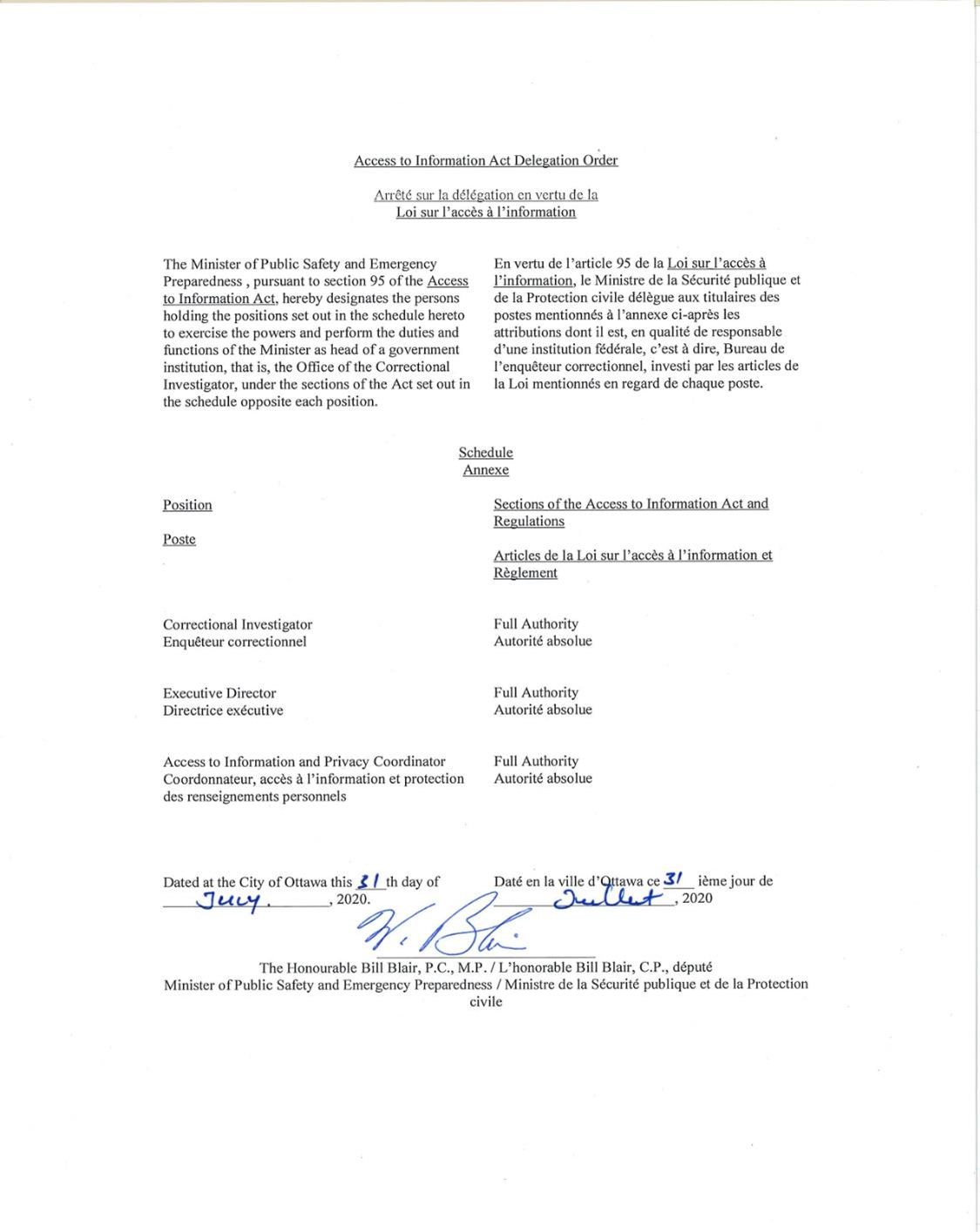
The Minister of Public Safety is the designated head of the institution for the Access to Information Act. The Correctional Investigator has been delegated full authority under the Access to Information Act by the Minister. Full authority under the Act has also been delegated to the Access to Information and Privacy Coordinator. The delegation of authority to administer the Act was confirmed by the Minister of Public Safety and Emergency Preparedness on July 31, 2020 (see Appendix A).
While the responsibilities of the ATIP Coordinator are assigned to the Director and Legal Counsel, the actual processing of requests and any associated activities are generally carried out by one (1) consultant. Given the limited number of requests, it is felt that this is the most cost-effective utilization of resources and delivery of these activities.
The ATIP Coordinator is accountable for the development, coordination and implementation of effective policies, guidelines, systems and procedures to ensure the responsibilities under the Access to Information Act are met and to enable appropriate processing and proper disclosure of information. The Coordinator is also responsible for related policies, systems and procedures emanating from the Act.
The main activities of the ATIP Coordinator include:
- Processing requests under the Act;
- Developing and maintaining policies, procedures and guidelines to ensure the Act is respected;
- Promoting awareness of the Act to ensure the OCI’s responsiveness to the obligations imposed on the government;
- Monitoring the OCI’s compliance with the Act, regulations and relevant procedures and policies;
- Preparing annual reports to Parliament and other statutory reports, as well as other materials that may be required by central agencies;
- Representing the OCI in dealings with the Treasury Board Secretariat, the Information Commissioner and other government agencies regarding the application of the Act as they relate to the OCI; and
- Supporting the OCI in meeting its commitments in relation to greater openness and transparency through proactive disclosure of information and the disclosure of information through informal avenues.
The OCI is not subject to any agreements under section 96 of the Access to Information Act.
During the Reporting Period
Ten (10) requests were received and there were none outstanding from the previous reporting period. Of these requests:
Three (3) were disclosed in part (30%)
Four (4) were released in its entirety (40%)
One (1) was exempted or excluded in its entirety (10%)
None were abandoned
Two (2) had no existing records (20%)
None were transferred
None were carried forward to the next reporting period
During this reporting period, all of the requests we received by way of email (100%).
Extensions were taken for two (2) of the requests. Extensions were taken to consult with other government departments. In order to alleviate extensive delays when consulting with the Correctional Service of Canada, the Office and CSC have come to an agreement that consultations will only be done when absolutely necessary.
We saw a slight decrease in the number of informal requests submitted. There were ten (10) informal requests received this year. Seven (7) of those requests were received through the on-line submission portal and three (3) were received by email. All informal requests were completed within 0-15 days. Nine (9) of those requests were for the re-release of records.
The Office could not meet the statutory response time for four (4) requests during the reporting period. In three (3) of the four (4) requests, the delays were attributable to delays due to consultations.
The OCI responded to 60% of requests within the legislated timelines. This is a slight decrease over the previous reporting period.
The Office received three (3) requests for consultation by another institution during the reporting period. All three (3) requests were responded to within 0-30 days.
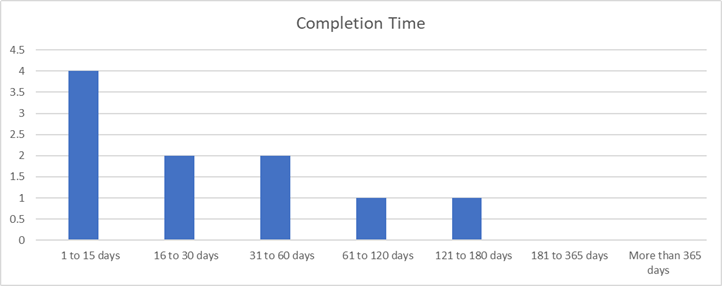
Monitoring of the time required to process these access requests was completed by the ATIP Coordinator in preparing the historical trend analysis in this report. The Executive Director and the ATIP Coordinator are advised by way of a briefing note when requests are not closed within the required time limits. The briefing note advises of the reason for the late response.
No training sessions were provided during the reporting period. Advice, guidance and recommendations were provided by the consultant on an as required basis to management and staff.
The OCI received no complaints during the reporting period.
Initiatives and Projects to Improve Access to Information
In alignment with the latest Treasury Board guidelines in Canada, our office has taken significant strides to enhance public access to government records. To facilitate this accessibility for inmates, we have implemented a policy to waive the $5 application fee for access to information requests. By removing this financial barrier, we aim to streamline the process and ensure that inmates can readily obtain the information they seek without undue burdens. Our commitment to promoting transparency and ease of access underscores our dedication to serving the public interest and fostering a more inclusive and responsive governance approach.
Costs
For 2024-25, the costs directly associated with the administration of the Access to Information Act are estimated at $24,865.
| Staff | $10,752 |
| Consultant fees | $14,113 |
| Other | $0 |
The associated employee resources for 2024-2025 are estimated at 0.216 FTE for administering the Access to Information Act.
Five-Year Historical Trend Analysis
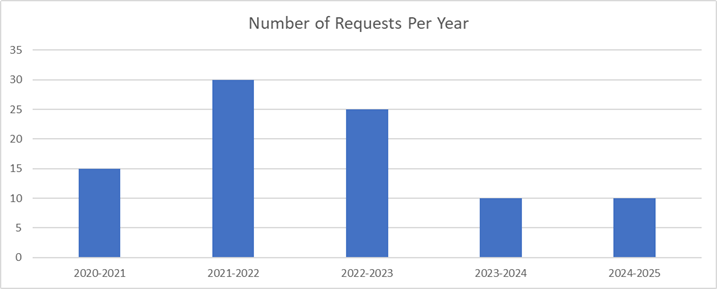
Over a five-year period, from 2020-2021 to 2024-2025, the OCI received an average of eighteen (18) requests annually.
Over the last five years, the OCI has maintained a 50% completion rate of requests processed between 1-60 days.
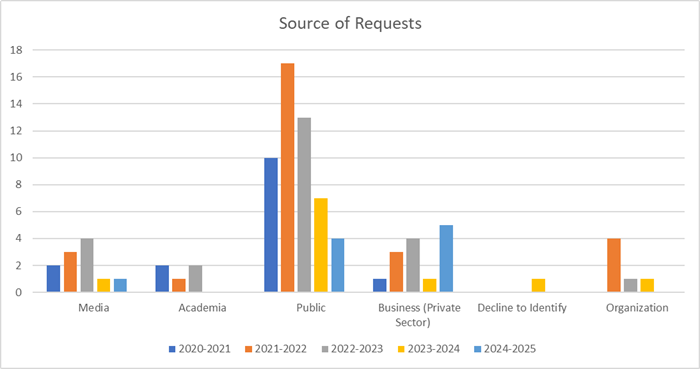
The Source of the Requests remains the most often the Public with an average of ten (10) requests followed by Media and Business with an average of two (2) requests each.
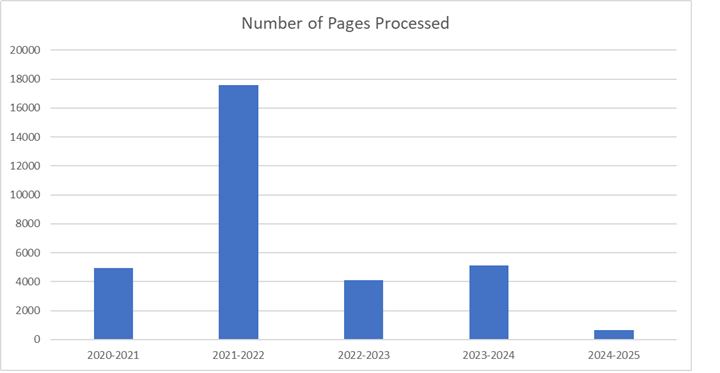
Concerning the number of pages processed, an average of six thousand four hundred and seventy-nine (6,479) was recorded.
The most frequently used exemptions were:
- 19(1) at 41%
- 16(1)(d) at 20%
- 16(1)(c) at 10%
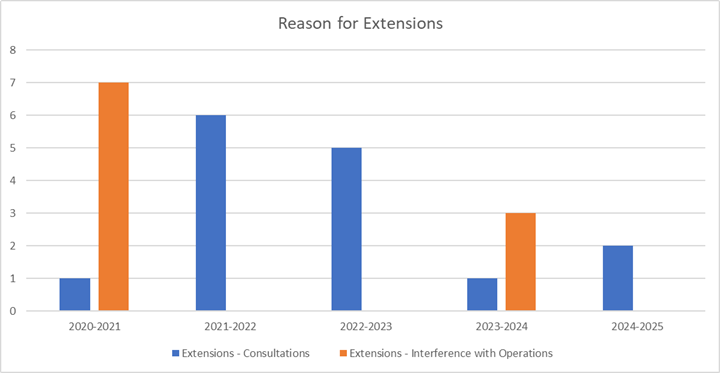
A total of fifteen (15) extensions for consultations were recorded for an average of three (3) extensions per reporting period. Because the majority of the records held by the Office were provided by or of interest to the Correctional Service of Canada, a large number of our files require a consultation with the CSC ATIP office.
A total of twelve (12) consultations were received from other government organizations for an average of two (2) consultations per reporting period.
This baseline data will continue to be used in future years to assess trends, inform ongoing improvement in the processing of ATI requests and implementing corrective measures where necessary.
APPENDIX A: Delegation Order