
On this page
- At a glance
- From the Correctional Investigator
- Plans to deliver on core responsibilities and internal services
- Department-wide considerations
- Planned spending and human resources
- Supplementary information tables
- Federal tax expenditures
- Corporate information
- Definitions
At a Glance
This departmental plan details Office of the Correctional Investigator (OCI)'s priorities, plans, and associated costs for the upcoming three fiscal years.
These plans align with the OCI's Vision, mission, raison d’être and operating context.
Key priorities
The OCI identified the following key priorities for 2026-27:
- Improve Service Standards to ensure more prompt resolution of incarcerated person’s complaints through efficient investigative processes;
- Implement team-based inspection model in compliance with international standards as a tool to oversee compliance with human rights standards;
- Implement a process that includes environmental scanning to develop criteria for conducting systemic and thematic investigations; and
- Pursue work on workplace Inclusion, Diversity, Equity, Accessibility, and Anti-Racism (IDEAA), and continue to be responsive to the gender and diversity of its clients by accelerating its Gender-based Analysis Plus (GBA Plus) efforts.
Comprehensive Expenditure Review
The government is committed to restraining the growth of day-to-day operational spending to make investments that will grow the economy and benefit Canadians. As part of meeting this commitment, OCI is planning the following spending reductions:
- 2026-27: $541,000
- 2027-28: $721,000
- 2028-29: $1,082,000
It is anticipated that these spending reductions will involve a decrease of approximately 8 full-time equivalents by 2028-29.
OCI will achieve these reductions by doing the following:
- Proposed reduction will be achieved through streamlining certain operational functions and merging of some functions within the Agency.
The figures in this departmental plan reflect these reductions.
Highlights for the Office of the Correctional Investigator in 2026-27
Building on the legacy of strong, principled oversight outlined by Dr. Zinger, the Office of the Correctional Investigator (OCI) enters 2026–27 as a year of transition and reflection. With the anticipated arrival of a new Correctional Investigator in early 2026, the OCI is poised to embrace fresh perspectives while remaining firmly committed to its mandate of independent oversight. This period will emphasize continuity, accessibility, and laying the groundwork for future priorities.
Looking Back to Build Ahead
The OCI is taking stock of a decade of recommendations by continuing to track and assess progress across six enduring priority areas:
- Security and Conditions of Confinement
- Physical and Mental Health
- Deaths in Custody
- Federally Sentenced Women
- Indigenous Corrections
- Interventions, Programs, and Reintegration to Community
This work will highlight systemic issues that remain unresolved and inform the development of forward-looking strategies under new leadership.
Reaffirming Oversight Principles
As the organization transitions, the OCI will uphold its commitment to the principles of fairness, independence, accountability, and impartiality which form the cornerstones for effective correctional oversight. These values will guide all activities during this period of transition while ensuring that federally sentenced individuals continue to have access to a trusted and responsive recourse mechanism.
Enhancing Accessibility and Service Delivery
The OCI will maintain its focus on accessibility, ensuring that its services are available to all federally sentenced individuals, regardless of background, language, ability, or location. Efforts will include improving communication tools and outreach strategies to reduce barriers and promote awareness of the Office’s mandate.
In 2026-27, total planned spending (including internal services) for the OCI is $7,682,095 and total planned full-time equivalent staff (including internal services) is 44.
Summary of planned results
The following provides a summary of the results the department plans to achieve in 2026-27 under its main areas of activity, called “core responsibilities.”
Core responsibility 1: Independent Oversight of federal corrections
In 2026–27, a key priority for the Independent Oversight of Federal Corrections will be strengthening organizational practices to uphold the principles of fairness, accountability, and human rights. This includes enhancing service standards to ensure timely and predictable resolution of complaints, while improving transparency in reporting outcomes. Visiting standards and monitoring practices will be reinforced to support more robust, team-based inspections, with greater integration between on-site observations and systemic investigations. These efforts reflect our ongoing commitment to safeguarding human dignity within federal institutions and advancing a correctional system that is safe, lawful, and humane.
Planned spending: $5,670,743
Planned human resources: 36
More information about the Independent Oversight of Federal Corrections can be found in the full plan.
For complete information on the Office of the Correctional Investigator’s total planned spending and human resources, read the Planned spending and human resources section of the full plan.
From the Correctional Investigator

The annual development of the Departmental Plan is more than a planning exercise: it is a moment to reaffirm the enduring importance of independent oversight and the principles that guide this work. At its core, our mandate is rooted in safeguarding human rights within federal institutions, in alignment with international standards and Canadian values.
Throughout my tenure, I have been steadfast in the belief that Canadians support these principles and expect their application to those serving sentences in federal penitentiaries. My Office’s priorities have always reflected this commitment - through complaint resolution, prison inspections, and systemic investigations aimed at ensuring a safe, lawful, and humane correctional system.
As I approach retirement, this Departmental Plan represents a personal milestone: the last one I will contribute to as Canada’s Correctional Investigator. It has been an extraordinary privilege to lead an Office dedicated to shining a light on issues often hidden from public view, advocating for fairness, accountability, and respect for human rights. Together, we have strengthened oversight, raised awareness of systemic inequities, and advanced a more humane correctional system; progress of which I am deeply proud.
Yet, the work of reform is far from complete. I urge all partners: government, civil society, and Canadians, to continue pressing for systemic change that prioritizes human dignity, equity, and accountability in corrections.
Looking ahead, my Office will continue to focus on improving service standards, strengthening systemic investigations, and fostering workplace inclusion, diversity, equity, accessibility, and anti-racism. I leave this work with confidence that the principles of dignity, fairness, and respect will remain at the heart of federal corrections oversight.
Ivan Zinger, JD., Ph.D.
Correctional Investigator
Plans to deliver on core responsibilities and internal services
Core responsibilities and internal services
Core responsibility 1: Independent Oversight of Federal Corrections
In this section
- Description
- Quality of life impacts
- Indicators, results and targets
- Plans to achieve results
- Gender-based Analysis Plus
- Planned resources to achieve results
- Program inventory
- Summary of changes to reporting framework since last year
Description
The Office of the Correctional Investigator (OCI) conducts investigations of complaints directed to the Correctional Service of Canada (CSC) by individual federal incarcerated or supervised offenders, and carries out systemic investigations of issues that affect large numbers of federal offenders. The OCI reviews all CSC investigations of deaths in custody and serious bodily injury cases to ensure CSC compliance with law and policy and conducts reviews of all use of force incidents. The OCIs investigative activities support a safe, lawful and humane federal correctional practice to ensure that federal correctional decisions and practices are compliant with human rights, law, policy, and are fair.
Quality of life impacts
This core responsibility contributes to the “Good Governance” domain of the Quality of Life Framework for Canada and, more specifically, “Discrimination and unfair treatment” and “Incarceration rate” indicators, through all of the activities mentioned in the core responsibility description.
Indicators, results and targets
This section presents details on the department’s indicators, the actual results from the three most recently reported fiscal years, the targets and target dates for Independent Oversight of Federal Corrections. Details are presented by departmental result.
Table 1: A safe, lawful and humane federal correctional practice
Table 1 provides a summary of the target and actual results for each indicator associated with the results under Independent Oversight of Federal Corrections.
| Departmental Result Indicators | Actual Results | 2026–27 Target | Date to achieve target |
|---|---|---|---|
| Percentage of systemic recommendations issued through annual or special reports that are accepted fully, in part or in principle by Correctional Services Canada.1 | 2022-23: Not available 2023-24: Not available 2024-25: Not available | At least 80% | March 31, 2027 |
| Percentage of individual complaints received by the Office that it responded to within the timeframes set by service standards. | 2022-23: Not available 2023-24: Not available 2024-25: Not available | At least 80% | March 31, 2027 |
[1] OCI provides recommendations for consideration; however, while acceptance indicates agreement, implementation rests with the responsible authorities.
Additional information on the detailed results and performance information for the Office of the Correctional Investigator’s program inventory is available on GC InfoBase.
Plans to achieve results
The following section describes the planned results for Independent Oversight of Federal Corrections in 2026-27.
A safe, lawful and humane federal correctional practice
In 2026-27, as is the case every year, the investigative complement of the OCI will focus on responding to issues and concerns that affect incarcerated individuals or those being supervised in the community and require resolution. The expectation is that this involvement will result in positive correctional outcomes for these individuals as well as the correctional system writ large through the completion of systemic and thematic reviews, prison inspections and investigations.
Results we plan to achieve
In this reporting year, the OCI will advance the following priorities, aimed at improving its services:
- Improve Service Standards to ensure more prompt resolution of incarcerated person’s complaints through efficient investigative processes by:
- Developing a follow-up based on last years’ implementation of a monitoring process that ensured that 85% of incarcerated persons’ complaints are resolved within 30 days of receipt and that the average treatment time remains under 15 days, and
- Developing a follow-up based on last years’ implementation of regular case review meetings to monitor the progress of ongoing investigations and identify any potential improvement processes.
- Implement team-based inspection model in compliance with international standards as a tool to oversee compliance with human rights standards, by:
- Implementing monitoring practices to ensure semi-annual inspections of each federal penitentiary to monitor adherence to human rights standards,
- Adopting reporting models, for institutional visits, that focuses on collective and systemic issues, and
- Adopting visiting standards that ensure a follow-up of conclusions from previous visits.
- Implement a process that includes environmental scanning to develop criteria for conducting systemic and thematic investigations through:
- Reporting on systemic investigations and recommendations concerning the issues identified as priorities for the correctional population in the Office’s annual report to Parliament,
- Using diverse teams to conduct interviews and field work, with federally sentenced individuals and correctional staff, and
- Reviewing policy compliance and leading the Office’s consultation on the development or revision of correctional directives and/or policies, with a focus on the impact of these policies and directives on diverse populations and those with unique needs.
- Pursue work on workplace Inclusion, Diversity, Equity, Accessibility, and Anti-Racism (IDEAA), and continue to be responsive to the gender and diversity of its clients by accelerating its Gender-based Analysis Plus (GBA Plus) efforts by:
- Increasing IDEAA awareness, including consulting and acquiring best practices,
- Developing and implementing an IDEAA action plan that addresses specific gaps and builds on opportunities,
- Sharing 4 awareness sessions to staff by March 31, 2027,
- Developing an organizational GBA Plus Framework with the support of subject-matter experts, and
- Embedding IDEAA principles in recruitment and performance management.
Gender-based Analysis Plus
The Office of the Correctional Investigator (OCI) is committed to the ongoing, effective application of GBA Plus principles and analysis in conducting its work and fulfilling its mission to ensure the fair and humane treatment of all persons serving federal sentences. The OCI continues to demonstrate its commitment to GBA Plus through its investigative work on a range of issues affecting federally sentenced individuals, with a focus on vulnerable populations including Indigenous Peoples, Black individuals, women, gender diverse individuals, aging offenders and individuals with mental health concerns. In 2026-27, the OCI will maintain this focus and highlight relevant investigations and statistics in its Annual Report to parliament.
Building on progress made in 2025, which included the appointment of a GBA Plus Champion, the creation of a standing committee, and the development of a comprehensive GBA Plus Framework for the OCI, the organization will further strengthen its governance in 2026-27 by developing and implementing an action plan with clear deliverables, with a focus on awareness-building and training, including the following:
- GBA Plus awareness activities and tools for the practical application of GBA Plus in the context of a micro-organization.
- Create an internal community of practice to provide guidance and support to staff in how to apply a GBA Plus lens to their work.
- Examine current data collection and analysis processes, including the intersection of multiple GBA Plus factors, to ensure they are properly considered in investigative and systemic work.
- Relatedly, in 2026–2027, the OCI will advance initiatives to promote workplace inclusion, diversity, equity, accessibility, and anti-racism (IDEAA). Key actions will include:
- Enhancing IDEAA awareness through consultation and adoption of best practices.
- Developing and implementing an IDEAA Action Plan to address identified gaps and leverage opportunities for improvement.
Planned resources to achieve results
Table 2: Planned resources to achieve results for Independent Oversight of Federal Corrections
Table 2 provides a summary of the planned spending and full-time equivalents required to achieve results.
| Resource | Planned |
|---|---|
| Spending | $5,670,743 |
| Full-time equivalents | 36 |
Complete financial and human resources information for the Office of the Correctional Investigator’s program inventory is available on GC InfoBase.
Program inventory
Independent Oversight of Federal Corrections is supported by the following programs:
- Ombuds for federally sentenced individuals
Additional information related to the program inventory for Independent Oversight of Federal Corrections is available on the Results page on GC InfoBase.
Summary of changes to reporting framework since last year
The Office of the Correctional Investigator’s Core Responsibility, Departmental Result and Program provide a meaningful representation of the organization’s mandate and remain unchanged in the 2026-27 Departmental Plan.
To better position the organization to articulate its results, the two indicators for the Departmental Result have been revised for 2026-27. The new indicators support an improved representation of OCI’s responsibility and level of influence, as they aim to strengthen reliability in tracking and reporting on results data.
Additional information on indicators is available as part of the detailed results and performance information on GC InfoBase.
Internal services
In this section
- Description
- Plans to achieve results
- Planned resources to achieve results
- Planning for contracts awarded to Indigenous businesses
Description
Internal services are the services that are provided within a department so that it can meet its corporate obligations and deliver its programs. There are 10 categories of internal services:
- acquisition management services
- communications services
- financial management services
- human resources management services
- information management services
- information technology services
- legal services
- material management services
- management and oversight services
- real property management services
Plans to achieve results
This section presents details the department’s plans to achieve results and meet targets for internal services.
The OCI will pursue work on workplace Inclusion, Diversity, Equity, Accessibility, and Anti-Racism (IDEAA), and continue to be responsive to the gender and diversity of its clients by accelerating its Gender-based Analysis Plus (GBA Plus) efforts.
This will include the following activities in 2028-27:
- Increase IDEAA awareness, including consulting and acquiring best practices.
- Develop and implement an IDEAA action plan that addresses specific gaps and builds on opportunities.
- Share 4 awareness sessions to staff by March 31, 2027.
- With the support of subject-matter experts, develop of an organizational GBA Plus Framework.
- Embedding IDEAA principles in recruitment and performance management.
Planned resources to achieve results
Table 3: Planned resources to achieve results for internal services this year
Table 3 provides a summary of the planned spending and full-time equivalents required to achieve results.
| Resource | Planned |
|---|---|
| Spending | $2,011,352 |
| Full-time equivalents | 8 |
Complete financial and human resources information for the Office of the Correctional Investigator’s program inventory is available on GC InfoBase.
Planning for contracts awarded to Indigenous businesses
Government of Canada departments are to meet a target of awarding at least 5% of the total value of contracts to Indigenous businesses each year. This commitment is to be fully implemented by the end of 2025-26.
The OCI surpassed the 5% requirement in 2025-26. As such, it will continue to implement similar measures such as continuing to identify Indigenous businesses available with the necessary expertise to meet its contracting needs and collaborate with service providers to implement planning and reporting methodology aimed at meeting and exceeding the 5% target namely using various contracting mechanisms made available.
Table 4: Percentage of contracts planned and awarded to Indigenous businesses
Table 4 presents the current, actual results with forecasted and planned results for the total percentage of contracts the department awarded to Indigenous businesses.
| 5% Reporting Field | 2024-25 Actual Result | 2025-26 Forecasted Result | 2026-27 Planned Result |
|---|---|---|---|
| Total percentage of contracts with Indigenous businesses | 13% | 6% | 15% |
Department-wide considerations
Related government priorities
United Nations 2030 Agenda for Sustainable Development and the UN Sustainable Development Goals
The OCI has commitments in support of three UN Sustainable Developments Goals (SDGs), namely Reduced Inequalities (SDG 10), Responsible Consumption and Production (SDG 12) and Climate Action (SDG 13). More information on the OCI’s contributions to Canada’s Federal Implementation Plan on the 2030 Agenda and the Federal Sustainable Development Strategy can be found in our Departmental Sustainable Development Strategy.
Planned spending and human resources
This section provides an overview of Office of the Correctional Investigator’s planned spending and human resources for the next three fiscal years and of planned spending for 2026-27 with actual spending from previous years.
In this section
Spending
This section presents an overview of the department's planned expenditures from 2023-24 to 2028-29.
Budgetary performance summary
Table 5 Three-year spending summary for core responsibilities and internal services (dollars)
Table 5 presents the Office of the Correctional Investigator’s spending over the past three years to carry out its core responsibilities and for internal services. Amounts for the 2025–26 fiscal year are forecasted based on spending to date.
| Core responsibilities and Internal services | 2023-2024 Actual Expenditures | 2024-25 Actual Expenditures | 2025-2026 Forecast Spending |
|---|---|---|---|
| Independent Oversight of Federal Corrections | $4,287,082 | $5,092,687 | $5,417,460 |
| Subtotal (s) | $4,287,082 | $5,092,687 | $5,417,460 |
| Internal services | $1,525,666 | $1,826,802 | $2,532,577.99 |
| Total (s) | $5,812,749 | $6,919,489 | $7,950,038 |
Analysis of the past three years of spending
The three-year spending increase reflects the phased implementation of the Program Integrity Fund, which was designed to gradually strengthen program delivery and ensure sustained operational capacity.
More financial information from previous years is available on the Finances section of GC Infobase.
Table 6 Planned three-year spending on core responsibilities and internal services (dollars)
Table 6 presents the Office of the Correctional Investigator’s planned spending over the next three years by core responsibilities and for internal services.
| Core responsibilities and Internal services | 2026-27 Planned Spending | 2027-28 Planned Spending | 2028-29 Planned Spending |
|---|---|---|---|
| Independent Oversight of Federal Corrections | $5,670,743 | $5,590,718 | $5,336,026 |
| Subtotal | $5,670,743 | $5,590,718 | $5,336,026 |
| Internal services | $2,011,352 | $1,919,277 | $1,849,067 |
| Total | $7,682,095 | $7,509,995 | $7,185,093 |
Analysis of the next three years of spending
The projected three-year reduction beginning in 2026–27 is attributable to the Comprehensive Expenditure Review, which introduced phased budget decreases of 7.5%, 10%, and 15% over the planning period.
More detailed financial information on planned spending is available on the Finances section of GC Infobase.
Funding
This section provides an overview of the department's voted and statutory funding for its core responsibilities and for internal services. For further information on funding authorities, consult the Government of Canada budgets and expenditures.
Graph 1: Approved funding (statutory and voted) over a six-year period
Graph 1 summarizes the department's approved voted and statutory funding from 2023-24 to 2028-29.
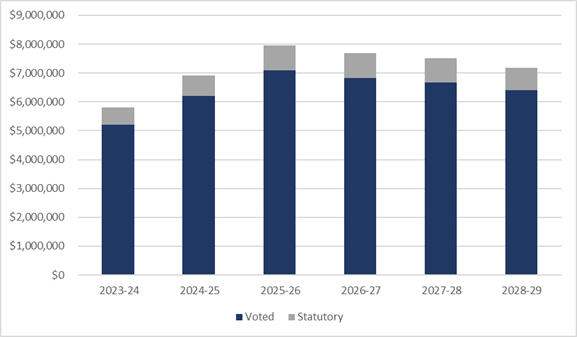
Graph 1 shows approved funding from 2023-24 to 2028-29 in bar format, differentiating between voted and statutory funding.
| Fiscal year | Total | Voted | Statutory |
|---|---|---|---|
| 2023-24 | $5,812,749 | $5,202,972 | $609,777 |
| 2024-25 | $6,919,489 | $6,198,360 | $721,129 |
| 2025-26 | $7,950,038 | $7,098,195 | $851,842 |
| 2026-27 | $7,682,095 | $6,828,341 | $853,754 |
| 2027-28 | $7,509,995 | $6,668,463 | $841,532 |
| 2028-29 | $7,185,093 | $6,397,728 | $787,365 |
Analysis of statutory and voted funding over a six-year period
The six-year spending profile reflects an initial increase driven by the gradual implementation of the Program Integrity Fund, followed by a phased reduction beginning in 2026–27 as part of the Comprehensive Expenditure Review, which introduced budget decreases of 7.5%, 10%, and 15% over the subsequent three years.
For further information on the Office of the Correctional Investigator’s departmental appropriations, consult the 2026-27 Main Estimates.
Future-oriented condensed statement of operations
The future-oriented condensed statement of operations provides an overview of the Office of the Correctional Investigator’s operations for 2025-26 to 2026-27.
Table 7 Future-oriented condensed statement of operations for the year ended March 31, 2027 (dollars)
Table 7 summarizes the expenses and revenues which net to the cost of operations before government funding and transfers for 2025-26 to 2026-27. The forecast and planned amounts in this statement of operations were prepared on an accrual basis. The forecast and planned amounts presented in other sections of the Departmental Plan were prepared on an expenditure basis. Amounts may therefore differ.
| Financial information | 2025-26 Forecast results | 2026-27 Planned results | Difference (Planned results minus forecasted) |
|---|---|---|---|
| Total expenses | $8,703,384 | $8,347,648 | -$355,736 |
| Total revenues | $0 | $0 | $0 |
| Net cost of operations before government funding and transfers | $8,703,384 | $8,347,648 | -$355,736 |
Analysis of forecasted and planned results
Reduction in planned spending is associated with the commencing of the Comprehensive Expenditure Review
A more detailed Future-Oriented Statement of Operations and associated Notes for 2026-27, including a reconciliation of the net cost of operations with the requested authorities, is available on the Office of the Correctional Investigator’s website.
Human resources
This section presents an overview of the department’s actual and planned human resources from 2023-24 to 2028-29.
Table 8: Actual human resources for core responsibilities and internal services
Table 8 shows a summary of human resources, in full-time equivalents, for the Office of the Correctional Investigator’s core responsibilities and for its internal services for the previous three fiscal years. Human resources for the 2025–26 fiscal year are forecasted based on year to date.
| Core responsibilities and internal services | 2023-24 Actual full-time equivalents | 2024-25 Actual full-time equivalents | 2025-26 Forecasted full-time equivalents |
|---|---|---|---|
| Independent Oversight of Federal Corrections | 26 | 30 | 33 |
| Subtotal | 26 | 30 | 33 |
| Internal services | 8 | 10 | 10 |
| Total | 34 | 40 | 43 |
Analysis of human resources over the last three years
The three FTE increase reflects the phased implementation of the Program Integrity Fund, which was designed to gradually strengthen program delivery and ensure sustained operational capacity.
Table 9: Human resources planning summary for core responsibilities and internal services
Table 9 shows information on human resources, in full-time equivalents, for each of the Office of the Correctional Investigator’s core responsibilities and for its internal services planned for the next three years.
| Core responsibilities and internal services | 2026-27 Planned full-time equivalents | 2027-28 Planned full-time equivalents | 2028-29 Planned full-time equivalents |
|---|---|---|---|
| Independent Oversight of Federal Corrections | 36 | 36 | 33 |
| Subtotal | 36 | 36 | 33 |
| Internal services | 8 | 7 | 7 |
| Total | 44 | 43 | 402 |
[2] The 40 FTEs are made up of the following: 6.45 in Internal Services and 33.88 for Operations. Numbers reflected in the table are rounded as per TBS policy.
Analysis of human resources for the next three years
The projected three-year FTE reduction beginning in 2026–27 is attributable to the Comprehensive Expenditure Review, which introduced phased budget decreases of 7.5%, 10%, and 15% over the planning period.
Supplementary information tables
Information on the Office of the Correctional Investigator’s departmental sustainable development strategy can be found on the Office of the Correctional Investigator’s website.
Federal tax expenditures
The Office of the Correctional Investigator’s Departmental Plan does not include information on tax expenditures.
The tax system can be used to achieve public policy objectives through the application of special measures such as low tax rates, exemptions, deductions, deferrals and credits. The Department of Finance Canada publishes cost estimates and projections for these measures each year in the Report on Federal Tax Expenditures.
This report also provides detailed background information on tax expenditures, including descriptions, objectives, historical information and references to related federal spending programs as well as evaluations and GBA Plus of tax expenditures.
Corporate information
Departmental profile
Appropriate minister(s): The Honourable Gary Anandasangaree, P.C., K.C., M.P.
Institutional head: Ivan Zinger, J.D., Ph.D
Ministerial portfolio: Public Safety
Enabling instrument(s): Corrections and Conditional Release Act
Year of incorporation / commencement: 1973 pursuant to the Inquiries Act and 1992 pursuant to the Corrections and Conditional Release Act.
Departmental contact information
Mailing address:
Office of the Correctional Investigator Canada
PO Box 3421, Station D
Ottawa, Ontario
K1P 6L4, Canada
Telephone: 1-877-885-8848
Fax: 613-990-0563
Email: org@oci-bec.gc.ca
Website(s): https://www.oci-bec.gc.ca
Definitions
appropriation (crédit)
Any authority of Parliament to pay money out of the Consolidated Revenue Fund.
budgetary expenditures (dépenses budgétaires)
Operating and capital expenditures; transfer payments to other levels of government, departments or individuals; and payments to Crown corporations.
core responsibility (responsabilité essentielle)
An enduring function or role performed by a department. The intentions of the department with respect to a core responsibility are reflected in one or more related departmental results that the department seeks to contribute to or influence.
Departmental Plan (plan ministériel)
A report on the plans and expected performance of an appropriated department over a 3year period. Departmental Plans are usually tabled in Parliament each spring.
departmental result (résultat ministériel)
A consequence or outcome that a department seeks to achieve. A departmental result is often outside departments’ immediate control, but it should be influenced by program-level outcomes.
departmental result indicator (indicateur de résultat ministériel)
A quantitative measure of progress on a departmental result.
departmental results framework (cadre ministériel des résultats)
A framework that connects the department’s core responsibilities to its departmental results and departmental result indicators.
Departmental Results Report (rapport sur les résultats ministériels)
A report on a department’s actual accomplishments against the plans, priorities and expected results set out in the corresponding Departmental Plan.
full-time equivalent (équivalent temps plein)
A measure of the extent to which an employee represents a full person-year charge against a departmental budget. For a particular position, the full-time equivalent figure is the ratio of number of hours the person actually works divided by the standard number of hours set out in the person’s collective agreement.
gender-based analysis plus (GBA Plus) (analyse comparative entre les sexes plus [ACS Plus])
Is an analytical tool used to support the development of responsive and inclusive policies, programs, and other initiatives. GBA Plus is a process for understanding who is impacted by the issue or opportunity being addressed by the initiative; identifying how the initiative could be tailored to meet diverse needs of the people most impacted; and anticipating and mitigating any barriers to accessing or benefitting from the initiative. GBA Plus is an intersectional analysis that goes beyond biological (sex) and socio-cultural (gender) differences to consider other factors, such as age, disability, education, ethnicity, economic status, geography (including rurality), language, race, religion, and sexual orientation.
Using GBA Plus involves taking a gender- and diversity-sensitive approach to our work. Considering all intersecting identity factors as part of GBA Plus, not only sex and gender, is a Government of Canada commitment.
government priorities (priorités gouvernementales)
For the purpose of the 2026-27 Departmental Plan, government priorities are the high-level themes outlining the government’s agenda in the 2025 Speech from the Throne.
horizontal initiative (initiative horizontale)
An initiative where two or more federal departments are given funding to pursue a shared outcome, often linked to a government priority.
Indigenous business (entreprise autochtones)
Requirements for verifying Indigenous businesses for the purposes of the departmental result report are available through the Indigenous Services Canada Mandatory minimum 5% Indigenous procurement target website.
non budgetary expenditures (dépenses non budgétaires)
Non-budgetary authorities that comprise assets and liabilities transactions for loans, investments and advances, or specified purpose accounts, that have been established under specific statutes or under non-statutory authorities in the Estimates and elsewhere. Non-budgetary transactions are those expenditures and receipts related to the government's financial claims on, and obligations to, outside parties. These consist of transactions in loans, investments and advances; in cash and accounts receivable; in public money received or collected for specified purposes; and in all other assets and liabilities. Other assets and liabilities, not specifically defined in G to P authority codes are to be recorded to an R authority code, which is the residual authority code for all other assets and liabilities.
performance (rendement)
What a department did with its resources to achieve its results, how well those results compare to what the department intended to achieve, and how well lessons learned have been identified.
performance indicator (indicateur de rendement)
A qualitative or quantitative means of measuring an output or outcome, with the intention of gauging the performance of a department, program, policy or initiative respecting expected results.
plan (plan)
The articulation of strategic choices, which provides information on how a department intends to achieve its priorities and associated results. Generally, a plan will explain the logic behind the strategies chosen and tend to focus on actions that lead to the expected result.
planned spending (dépenses prévues)
For Departmental Plans and Departmental Results Reports, planned spending refers to those amounts presented in Main Estimates.
A department is expected to be aware of the authorities that it has sought and received. The determination of planned spending is a departmental responsibility, and departments must be able to defend the expenditure and accrual numbers presented in their Departmental Plans and Departmental Results Reports.
program (programme)
Individual or groups of services, activities or combinations thereof that are managed together within the department and focus on a specific set of outputs, outcomes or service levels.
program inventory (répertoire des programmes)
Identifies all the department’s programs and describes how resources are organized to contribute to the department’s core responsibilities and results.
result (résultat)
A consequence attributed, in part, to a department, policy, program or initiative. Results are not within the control of a single department, policy, program or initiative; instead they are within the area of the department’s influence.
statutory expenditures (dépenses législatives)
Expenditures that Parliament has approved through legislation other than appropriation acts. The legislation sets out the purpose of the expenditures and the terms and conditions under which they may be made.
target (cible)
A measurable performance or success level that a department, program or initiative plans to achieve within a specified time period. Targets can be either quantitative or qualitative.
voted expenditures (dépenses votées)
Expenditures that Parliament approves annually through an appropriation act. The vote wording becomes the governing conditions under which these expenditures may be made.