
From the Correctional Investigator

I am pleased to present my last Departmental Results Report as the Correctional Investigator of the Office of the Correctional Investigator (Office). Fulfilling our mandate is my utmost priority. Nevertheless, this fiscal period my Office also focused on augmenting the effectiveness and resiliency within our organization.
As is the case every year, our investigative team responds to issues and concerns that affect offenders and require resolution. In this reporting period, my Office processed 4,352 inquiries, conducted six national investigations into access to and quality of mental health care, spent 433 days in federal correctional institutions, and held 1,383 interviews.
Operationally, we created investigative ‘teams’ that prioritize tandem institutional visits to ensure consistency and enhanced oversight. This approach not only fosters specialized knowledge and higher quality operational outcomes, but it also enables the identification of thematic issues and trends. We introduced a triage process for Use of Force cases to streamline workflow and prioritize urgent, critical reviews with effective resource allocation. Moreover, we standardized reporting, data entry and visualization, and visit-related documentation recording processes to improve on our ability to report on systemic issues and successful resolutions.
This fiscal year our Office led six investigations examining the quality of mental health care for federally sentenced individuals, including the provision of care for individuals with complex mental health needs and cognitive deficits, trauma-informed approaches for incarcerated women, and the mental health needs and services available to Indigenous Peoples in federal custody. The findings and recommendations are the focus of our 2024-25 annual report.
We collaborated with the Office of the Ombudsperson for Victims of Crime on one of those six investigations that assessed and addressed trauma in federally sentenced women. It afforded great rigor and compassion, but also rich knowledge sharing within the investigative team. Moreover, we reaped the benefits of collaboration with stakeholders in our work with Indigenous rightsholders and organizations, and in our engagement with Healing Lodges. We continue to have shared concerns of Indigenous overrepresentation and over classification in federal prisons and see the incredible benefits of the various community-run Healing Lodge models across the country.
Our Office’s internal work to enhance processes and optimize structure continued throughout this reporting period. While the modernization of our performance framework will improve measurement and reporting on our core responsibility, our efforts to continue to optimize organizational structure and career pathways will support professional development and sound succession planning. Our Office continues its challenging transition to digital-first and is advancing its implementation of a modern information management system, which will foster greater collaboration amongst OCI staff. A new GBA Plus Advisory Committee was created to further our diversity and inclusion program, and we invested in a communications and outreach specialist to implement intentional, impactful strategies.
Despite the challenges our micro-organization encounters, this reporting period has been significantly satisfying both as the Correctional Investigator and the head of this organization. Indeed, it has been my privilege to serve as Correctional Investigator over the last nine years and to work with a group of dedicated, committed people invested in the fair and humane treatment of those serving federal sentences. As I approach my departure, I am more and more confident that the work of this Office will not only continue but will get stronger in its ability to effect positive change.
Ivan Zinger J.D., Ph.D.
Correctional Investigator of Canada
Results – what we achieved
Core responsibilities and internal services
Core responsibility 1: Independent Oversight of Federal Corrections
In this section
- Description
- Quality of life impact
- Progress on results
- Details on results
- Key risks
- Resources required to achieve results
- Related government-wide priorities
- Program inventory
Description
The Office of the Correctional Investigator (OCI) conducts investigations of complaints directed to the Correctional Service of Canada (CSC) by individual federal incarcerated or supervised offenders and carries out systemic investigations of issues that affect large numbers of federal off enders. The OCI reviews all CSC investigations of deaths in custody and serious bodily injury cases to ensure CSC compliance with law and policy and conducts reviews of all use of force incidents. The OCIs investigative activities support a safe, lawful and humane federal correctional practice to ensure that federal correctional decisions and practices are incompliance with human rights, law, policy, and are fair.
Quality of life impacts
This core responsibility contributes to the “Good Governance” domain of the Quality of Life Framework for Canada and, more specifically, “Discrimination and unfair treatment” and “Incarceration rate” indicators, through all of the activities mentioned in the core responsibility description.
Progress on results
This section details the department’s performance against its targets for each departmental result under Core responsibility 1: Independent Oversight of Federal Corrections.
Table 1: A safe, lawful and humane federal correctional practice
Table 1 shows the target, the date to achieve the target and the actual result for each indicator under A safe, lawful and humane federal correctional practice in the last three fiscal years.
| Departmental Result Indicators | Target | Date to achieve target | Actual Results |
| Percentage of recommendations made in relation to individual offender complaints that were addressed by the Correctional Service of Canada. | 90% | March 31, 2025 | 2022–23: 92% 2023–24: 91% 2024–25: 87.5% |
| Percentage of recommendations made in relation to the Office of the Correctional investigator’s corporate priorities that were addressed by the Correctional Service of Canada. | 100% | March 31, 2025 | 2022–23: 80% 2023–24: 80% 2024–25: 80% |
The Results section of the Infographic for the Office of the Correctional Investigator on GC Infobase page provides additional information on results and performance related to its program inventory.
Details on results
The following section describes the results for the Independent Oversight of Federal Corrections in 2023–24 compared with the planned results set out in the Office of the Correctional Investigator’s departmental plan for the year.
A safe, lawful and humane federal correctional practice
Results achieved
The results achieved in relation to the percentage of recommendations made in relation to individual offender complaints that were addressed by the Correctional Service of Canada:
- The Office of the Correctional Investigator (OCI) received and processed 4,352 formal complaints against the Correctional Service of Canada during the reporting period of April 2024 to March 2025. The Investigations Team, consisting of Early Resolution Officers, Senior Investigators as well as the Senior Management cadre (when required), developed recommendations for resolution and were successful in securing the Correctional Service of Canada’s commitment to address the issue at the source of the complaint 87.5% of the time.
- The result for 2024-25 fell 2.5% below the established target of 90% but was relatively consistent with previous results while the total number of formal complaints increased 1.2% over the same period the previous year. There is a variability in both the nature of complaints received and Correctional Service of Canada’s ability to address recommendations.
The results achieved in relation to percentage of recommendations made in relation to the OCI’s corporate priorities that were addressed by the Correctional Service of Canada:
- The result achieved in the reporting period is consistent with results in previous years. While the aim is that all recommendations are addressed, limitations in the OCI’s level of influence, given that its recommendations are non-binding, means that achieving 100% on an annual basis is not realistic. Work has been undertaken to revisit indicators and targets to better reflect performance of the Office within its mandate. However, any changes identified will not be reflected until the 2026-27 reporting cycle at the earliest.
The OCI also made progress in addressing the key priorities outlined in the Departmental Plan.
Identifying and addressing disparate outcomes for Indigenous and Black incarcerated individuals with the goal of reducing their overall overrepresentation in Canadian prisons.
- The OCI captured statistics to assist in quantifying the disparities and interviewed individuals in these populations to help identify specific information on the nature of their complaints. Engagement with Healing Lodge executives was held to understand the shared concern of Indigenous over representation and opportunities to collaborate toward reducing it.
Adjusting the organizational structure to improve effectiveness and resilience.
- As a result of securing additional program integrity funding, the OCI was able to solidify its investigative capacity, while at the same time modifying its structure and operating procedures to deliver better results for federally incarcerated individuals.
- A Communications and Outreach function was created to enhance public reporting, convey the organization's goals, values, and initiatives to various audiences, as well as facilitate the exchange information with internal and external stakeholders.
Improving organizational capacity in planning and conducting systemic investigations and prison inspections.
- OCI’s leads, cross-departmental teams, and external service providers tasked with conducting systemic investigations collaborated in both planning and executing visits in a structured manner. Close to 60% of institutional visits were conducted by teams of at least two staff members, improving both the effectiveness of the investigative activities and reducing the psychosocial risk factors associated with this activity for employees.
Optimizing information and data collection to better identify trends, the evolution of specific issues and to better report on success stories.
- The OCI standardized the way in which institutional visit reports, issues, and associated data are recorded. Visit-related documentation now consistently includes outstanding, unresolved matters to better track and report on specific issues and measure the proportion of recommendations that have been actioned. The OCI also leveraged existing data visualization software to better plan track and report on key oversight metrics.
Key risks
The OCI’s client base and network of stakeholders are dispersed in a large number of geographically remote locations throughout Canada. The very nature of essential information exchanges between the OCI, incarcerated individuals, and the Correctional Service of Canada requires both secure and confidential means of communications. While the OCI relies on standard government-based communication systems, a new Voice over IP telephone system was implemented for the efficient and secure processing of the OCI’s toll-free line. Access to sensitive information was limited and encrypted when shared with ongoing integrity supported by the completion of cybersecurity training by all employees.
The resolution of complaints in an environment traditionally closed to public scrutiny requires that the OCI not only be, but be seen to be, independent of the Correctional Service of Canada, Public Safety, and the Minister. The OCI continues to review the corporate ties it has with some of these organizations with a view of strengthening its processes to support its independence. The OCI has an agreement that includes a data-sharing provision that limits Correctional Services Canada’s access to the OCI’s electronic information and data. The OCI continues to be custodian for its paper and electronic records, with responsibility to implement retention and disposition policies according to the Library and Archives Canada Act.
Resources required to achieve results
Table 2: Snapshot of resources required for the Independent Oversight of Federal Corrections
Table 2 provides a summary of the planned and actual spending and full-time equivalents required to achieve results.
| Resource | Planned | Actual |
| Spending | $5,223,687 | $5,092,687 |
| Full-time equivalents | 35 | 30 |
The Finances section of the Infographic for the Office of the Correctional Investigator on GC Infobase page and the People section of the Infographic for the Office of the Correctional Investigator on GC Infobase page provide complete financial and human resources information related to its program inventory.
Related government-wide priorities
This section highlights government priorities that are being addressed through this core responsibility.
Gender-based analysis plus
The Office of the Correctional Investigator (OCI) is committed to the ongoing, effective application of GBA Plus principles and analysis in conducting its work and fulfilling its mission to ensure the fair and humane treatment of all persons serving federal sentences. Given that the OCI only has one program, all relevant information about GBA Plus can be found in the GBA Plus Supplementary Information Table.
United Nations 2030 Agenda for Sustainable Development and the Sustainable Development Goals
The 2022 to 2026 Federal Sustainable Development Strategy (FSDS) presents the Government of Canada’s sustainable development goals and targets, as required by the Federal Sustainable Development Act. This is the first FSDS to be framed using the 17 Sustainable Development Goals (SDGs) of the United Nations 2030 Agenda and provides a balanced view of the environmental, social, and economic dimensions of sustainable development.
More information on the Office of the Correctional Investigator’s contributions to Canada’s Federal Implementation Plan on the 2030 Agenda and the Federal Sustainable Development Strategy can be found in our Departmental Sustainable Development Strategy.
Program inventory
The following program supports the Office of the Correctional Investigator’s Core Responsibility: Independent Oversight of Federal Corrections:
- Ombuds for federally sentenced individuals
Additional information related to the program inventory for Independent Oversight of Federal Corrections is available on the Results page on GC InfoBase.
Internal services
In this section
- Description
- Progress on results
- Resources required to achieve results
- Contracts awarded to Indigenous business
Description
Internal services refer to the activities and resources that support a department in its work to meet its corporate obligations and deliver its programs. The 10 categories of internal services are:
- Management and Oversight Services
- Communications Services
- Legal Services
- Human Resources Management
- Financial Management
- Information Management
- Information Technology
- Real Property
- Materiel
- Acquisitions
Progress on results
This section presents details on how the department performed to achieve results and meet targets for internal services.
As with most micro-organizations with limited internal services capacity, the OCI has several memoranda of understanding (MOUs) in place with service providers for core internal services such as financial administration services; pay and compensation; procurement; staffing; and other human resources services. These MOUs include quality control, oversight, monitoring, and performance indicators.
The OCI has made progress in addressing the following internal services key priority outlined in the Departmental Plan:
Strengthening the organization’s position as an employer of choice and thus ensuring “la relève” of the current and future key positions.
- The OCI adjusted its organizational structure to improve overall effectiveness and resilience, namely by providing clearer career pathways and better alignment of roles, which is essential for succession planning and talent retention.
- The OCI also designed and rolled out a mandatory training program aligned with organizational priorities, including leadership development, equity, diversity and inclusion (EDI), and workplace safety. It also took steps to further integrate training identification into performance and development planning to reinforce accountability.
- Additionally, to facilitate succession planning, the OCI made language training more widely available to employees and also made greater use of performance agreements to support meaningful discussions about career progression.
Beyond the above priority, the OCI made substantial progress in its digital office project in reducing its reliance on paper and ensuring that paper records were treated in accordance with record disposition requirements. The OCI initiated a procurement process to retain external expertise to develop an information architecture and the implementation of a new information management system, such as GCDOCS or Sharepoint which will further to its objective to improve information and records management, while enabling new collaborative tools.
Additionally, the OCI has solidified its financial management capacity which has resulted in strengthened financial management practices, including the introduction of elements of zero-based budgeting, clearer accountabilities and stronger internal controls.
Resources required to achieve results
Table 3: Resources required to achieve results fort internal services this year
Table 3 provides a summary of the planned and actual spending and full-time equivalents required to achieve results.
| Resource | Planned | Actual |
| Spending | $2,238,723 | $1,826,802 |
| Full-time equivalents | 10 | 10 |
The Finances section of the Infographic for the Office of the Correctional Investigator on GC Infobase and the People section of the Infographic for the Office of the Correctional Investigator on GC Infobase provide complete financial and human resources information related to its program inventory.
Contracts awarded to Indigenous businesses
Government of Canada departments are required to award at least 5% of the total value of contracts to Indigenous businesses every year.
Office of the Correctional Investigator’s result for 2024-25:
Table 4: Total value of contracts awarded to Indigenous businesses1
As shown in Table 4, the Office of the Correctional Investigator awarded 13 % of the total value of all contracts to Indigenous businesses for the fiscal year.
| Contracting performance indicators | 2024-25 Results |
| Total value of contracts awarded to Indigenous businesses2 (A) | $62,644 |
| Total value of contracts awarded to Indigenous and non‑Indigenous businesses (B) | $494,646 |
| Value of exceptions approved by deputy head (C) | $0 |
| Proportion of contracts awarded to Indigenous businesses [A / (B−C) × 100] | 13% |
1. Contract” is a binding agreement for the procurement of a good, service, or construction and does not include real property leases. It includes contract amendments and contracts entered into by means of acquisition cards of more than $10,000.00.
2. Includes contract amendments with Indigenous businesses and contracts that were entered into with Indigenous businesses by means of acquisition cards above $10,000.00 ($10K), and may include subcontracts with Indigenous businesses.
In its 2025–26 Departmental Plan, the Office of the Correctional Investigator estimated that it would award 5% of the total value of its contracts to Indigenous businesses by the end of 2024–25.
Spending and human resources
In this section
Spending
This section presents an overview of the department's actual and planned expenditures from 2022–23 to 2027–28.
Refocusing Government Spending
While not officially part of this spending reduction exercise, to respect the spirit of this exercise, the Office of the Correctional Investigator undertook the following measures in 2024-25.
- Introduced elements of zero-based budgeting;
- Increased financial management literacy across the management team;
- Leveraged memoranda of understanding (MOUs) with larger government organizations to support program elivery while maintaining fiscal prudence, namely by maximizing government capacity and expertise, while reducing duplication and corporate services costs;
- Advocated for reduced or adapted reporting burden for micro-organizations; and,
- Restricted staffing to critical positions while waiting for decisions on refocusing government spending and their impacts on OCI.
Budgetary performance summary
Table 5. Actual three-year spending on core responsibilities and internal services (dollars)
Table 5 shows the money that the Office of the Correctional Investigator spent in each of the past three years on its core responsibilities and on internal services.
| Core responsibility and internal services | 2024–25 Main Estimates | 2024–25 total authorities available for use | Actual spending over three years (authorities used) |
| Independent Oversight of Federal Corrections | $5,440,463 | $5,616,020 |
|
| Internal services | $2,021,947 | $2,087,193 |
|
| Total | $7,462,410 | $7,703,213 |
|
Analysis of the past three years of spending
The variance between the 2024-25 Main Estimates amount and the total authorities available for use is related to residual effects of incremental funding (Program Integrity TB submission) received through an allotment increase and the supplementary estimates exercise in the reporting period. This influx of new authorities is also evident in spending in 2024-25, which is higher than the previous two fiscal years. OCI took a prudent and conservative approach in spending during the refocusing of government spending phases 1 and 2, resulting in lower spending. Authorities and spending will continue to stabilize in the next two fiscal years as the total and permanent allocation stemming from the Program Integrity TB submission will be reflected in the Main Estimates.
The Finances section of the Infographic for the Office of the Correctional Investigator on GC Infobase offers more financial information from previous years.
Table 6. Planned three-year spending on the core responsibility and internal services (dollars)
Table 6 presents how much money the Office of the Correctional Investigator plans to spend over the next three years to carry out its core responsibility and for internal services.
| Core responsibility and internal services | 2025–26 planned spending | 2026–27 planned spending | 2027–28 planned spending |
| Independent Oversight of Federal Corrections | $5,832,410 | $5,892,257 | $5,892,257 |
| Subtotal | $5,832,410 | $5,892,257 | $5,892,257 |
| Internal services | $2,231,108 | $2,201,234 | $2,201,234 |
| Total | $8,063,518 | $8,093,491 | $8,093,491 |
Analysis of the next three years of spending
Over the next three fiscal years and thereafter, the Office of the Correctional Investigator’s spending will stabilize at $8.1 million annually. The organization is not planning for significant spending increases over this period; however, minor incremental spending increases related to compensation and pay list allocations are expected. Spending is required to achieve the Office’s important mandate as the Ombuds for federal offenders.
The Finances section of the Infographic the Office of the Correctional Investigator on GC Infobase offers more detailed financial information related to future years.
Funding
This section provides an overview of the department's voted and statutory funding for its core responsibilities and for internal services. Consult the Government of Canada budgets and expenditures for further information on funding authorities.
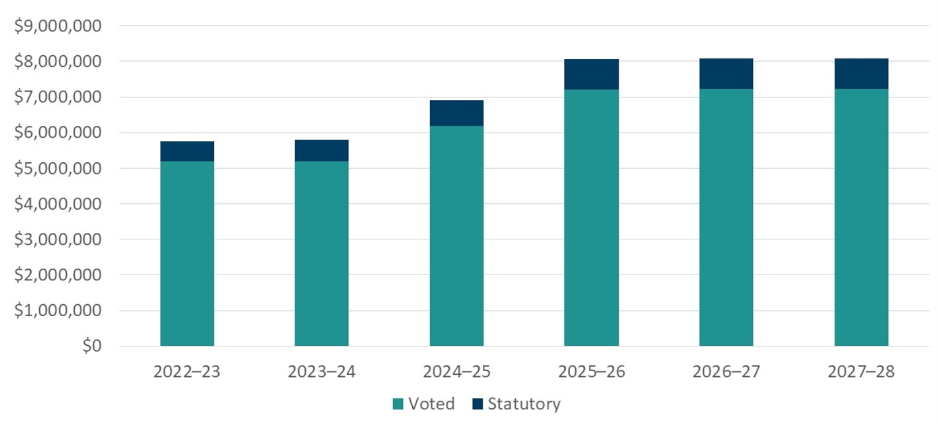
Graph 1: Approved funding (statutory and voted) over a six-year period
Graph 1 summarizes the department's approved voted and statutory funding from 2022-23 to 2027-28.
Text version of graph 1
Graph 1 includes the following information in a bar graph:
Fiscal year | Statutory | Voted | Total | Fiscal year | Statutory | Voted |
2022-23 | $573,609 | $5,188,105 | $5,761,714 | 2022-23 | $573,609 | $5,188,105 |
2023-24 | $609,777 | $5,202,972 | $5,812,749 | 2023-24 | $609,777 | $5,202,972 |
2024-25 | $721,129 | $6,198,360 | 2024-25 | $721,129 | $6,198,360 | |
2025-26 | $851,843 | $7,211,675 | $8,063,518 | 2025-26 | $851,843 | $7,211,675 |
2026-27 | $856,151 | $7,237,340 | $8,093,491 | 2026-27 | $856,151 | $7,237,340 |
2027-28 | $856,151 | $7,237,340 | $8,093,491 | 2027-28 | $856,151 | $7,237,340 |
Analysis of statutory and voted funding over a six-year period
The variance between 2023-24 and 2024-25 is attributable to an increase in spending to implement the program integrity funding needed for an organizational restructure. The year over year change from the funding will stabilize starting in 2025-26 and will remain consistent in the subsequent two years.
Consult the Public Accounts of Canada for further information on the Office of the Correctional Investigator’s departmental voted and statutory expenditures.
Financial statement highlights
Office of the Correctional Investigator’s Financial Statements (Unaudited) for the Year Ended March 31, 2025.
Table 7. Condensed Statement of Operations (unaudited) for the year ended March 31, 2024 (dollars)
Table 7 summarizes the expenses and revenues for 2024–25 which net to the cost of operations before government funding and transfers.
| Financial information | 2024–25 actual results | 2024–25 planned results | Difference (actual results minus planned) |
| Total expenses | $7,684,626 | $7,951,424 | -$266,798 |
| Total revenues | $0 | $0 | $0 |
| Net cost of operations before government funding and transfers | $7,684,626 | $7,951,424 | -$266,798 |
Analysis of expenses and revenues for 2024-25
The 2024–25 planned results information is provided in the Office of the Correctional Investigator’s Future-Oriented Statement of Operations and Notes 2024–25.
Table 8: Condensed Statement of Operations (unaudited or audited) for 2023-24 and 2024-25 (dollars)
Table 8 summarizes actual expenses and revenues and shows the net cost of operations before government funding and transfers.
| Financial information | 2024–25 actual results | 2023–24 actual results | Difference (2024-25 minus 2023-24) |
| Total expenses | $7,684,626 | $6,448,460 | $1,236,166 |
| Total revenues | $0 | $0 | $0 |
| Net cost of operations before government funding and transfers | $7,684,626 | $6,448,460 | $1,236,166 |
Analysis of differences in expenses and revenues between 2023-24 and 2024-25
The variance between 2023-24 and 2024-25 is attributable to an increase in spending to implement the program integrity funding needed for an organizational restructure.
Table 9. Condensed Statement of Financial Position (unaudited or audited) as of March 31, 2025 (dollars)
Table 9 provides a brief snapshot of the amounts the department owes or must spend (liabilities) and its available resources (assets), which helps to indicate its ability to carry out programs and services.
| Financial information | Actual fiscal year (2024–25) | Previous fiscal year (2023–24) | Difference (2024–25 minus 2023–24) |
| Total net liabilities | $932,092 | $747,206 | $184,886 |
| Total net financial assets | $616,850 | $481,709 | $135,141 |
| Departmental net debt | $135,141 | $265,497 | $49,745 |
| Total non-financial assets | $0 | $0 | $0 |
| Departmental net financial position | -$315,242 | -$265,497 | -$49,745 |
Analysis of department’s liabilities and assets since last fiscal year
The increase in total liabilities is mainly attributable to an increase in accrued liabilities, these are obligations the OCI has incurred but have not yet paid by year-end. The increase in total net financial assets is mainly attributable to an increase in the amount due from the Consolidated Revenue Fund to discharge accounts payable and accrued liabilities.
Human resources
This section presents an overview of the department’s actual and planned human resources from 2022–23 to 2027–28.
Table 10. Actual human resources for core responsibilities and internal services
Table 10 shows a summary in full-time equivalents of human resources for the Office of the Correctional Investigator’s core responsibilities and for its internal services for the previous three fiscal years.
| Core responsibilities and internal services | 2022–23 actual full-time equivalents | 2023–24 actual full-time equivalents | 2024–25 actual full-time equivalents |
| Independent Oversight of Federal Corrections | 28 | 26 | 30 |
| Subtotal | 28 | 26 | 30 |
| Internal services | 8 | 8 | 10 |
| Total | 36 | 34 | 40 |
Analysis of human resources over the last three years
The variance between the 2022-23 actual full-time equivalents and planned full-time equivalents for 2023-24 is due to turnover and staffing delays, during that time OCI followed a conservative approach to spending given the refocus of government spending initiative. The increase in 2024-25 reflects progress made in staffing to address program integrity.
Table 11. Human resources planning summary for core responsibility and internal services
Table 11 shows the planned full-time equivalents for each of the Office of the Correctional Investigator’s core responsibilities and for its internal services for the next three years. Human resources for the current fiscal year are forecast based on year to date.
| Core responsibilities and internal services | 2025–26 planned full-time equivalents | 2026–27 planned full-time equivalents | 2027–28 planned full-time equivalents |
| Independent Oversight of Federal Corrections | 38 | 38 | 38 |
| Subtotal | 38 | 38 | 38 |
| Internal services | 10 | 10 | 10 |
| Total | 48 | 48 | 48 |
Analysis of human resources for the next three years
Following an increase for 2025-26, the year over year change in human resources will stabilize and remain consistent in the subsequent two years.
Supplementary information tables
The following supplementary information tables are available on the Office of the Correctional Investigator’s website:
Federal tax expenditures
The tax system can be used to achieve public policy objectives through the application of special measures such as low tax rates, exemptions, deductions, deferrals and credits. The Department of Finance Canada publishes cost estimates and projections for these measures each year in the Report on Federal Tax Expenditures. This report also provides detailed background information on tax expenditures, including descriptions, objectives, historical information and references to related federal spending programs as well as evaluations and GBA Plus of tax expenditures.
Corporate information
Departmental profile
Appropriate minister(s): The Honourable Gary Anandasangaree, P.C., M.P.
Institutional head: Ivan Zinger, J.D., Ph.D
Ministerial portfolio: Public Safety
Enabling instrument(s): Corrections and Conditional Release Act
Year of incorporation / commencement: 1973 pursuant to the Inquiries Act and 1992 pursuant to the Corrections and Conditional Release Act.
Mailing address:
Office of the Correctional Investigator Canada
PO Box 3421, Station D
Ottawa, Ontario
K1P 6L4, Canada
Telephone: 1-877-885-8848
Fax: 613-990-0563
Email: org@oci-bec.gc.ca
Website(s): www.oci-bec.gc.ca
Definitions
appropriation (crédit)
Any authority of Parliament to pay money out of the Consolidated Revenue Fund.
budgetary expenditures (dépenses budgétaires)
Operating and capital expenditures; transfer payments to other levels of government, departments or individuals; and payments to Crown corporations.
core responsibility (responsabilité essentielle)
An enduring function or role of a department. The departmental results listed for a core responsibility reflect the outcomes that the department seeks to influence or achieve.
Departmental Plan (plan ministériel)
A report that outlines the anticipated activities and expected performance of an appropriated department over a 3-year period. Departmental Plans are usually tabled in Parliament in spring.
departmental priority (priorité)
A plan, project or activity that a department focuses and reports on during a specific planning period. Priorities represent the most important things to be done or those to be addressed first to help achieve the desired departmental results.
departmental result (résultat ministériel)
A high-level outcome related to the core responsibilities of a department.
departmental result indicator (indicateur de résultat ministériel)
A quantitative or qualitative measure that assesses progress toward a departmental result.
departmental results framework (cadre ministériel des résultats)
A framework that connects the department’s core responsibilities to its departmental results and departmental result indicators.
Departmental Results Report (rapport sur les résultats ministériels)
A report outlining a department’s accomplishments against the plans, priorities and expected results set out in the corresponding Departmental Plan.
Full-time equivalent (équivalent temps plein)
Measures the person years in a departmental budget. An employee's scheduled hours per week divided by the employer's hours for a full-time workweek calculates a full-time equivalent. For example, an employee who works 20 hours in a 40-hour standard workweek represents a 0.5 full-time equivalent.
Gender-based analysis plus (GBA Plus) (analyse comparative entre les sexes plus [ACS Plus])
An analytical tool that helps to understand the ways diverse individuals experience policies, programs and other initiatives. Applying GBA Plus to policies, programs and other initiatives helps to identify the different needs of the people affected, the ways to be more responsive and inclusive, and the methods to anticipate and mitigate potential barriers to accessing or benefitting from the initiative. GBA Plus goes beyond biological (sex) and socio-cultural (gender) differences to consider other factors, such as age, disability, education, ethnicity, economic status, geography (including rurality), language, race, religion, and sexual orientation.
government-wide priorities (priorités pangouvernementales)
For the purpose of the 2024–25 Departmental Results Report, government priorities are the high-level themes outlining the government’s agenda as announced in the 2021 Speech from the Throne.
horizontal initiative (initiative horizontale)
A program, project or other initiative where two or more federal departments receive funding to work collaboratively on a shared outcome usually linked to a government priority, and where the ministers involved agree to designate it as horizontal. Specific reporting requirements apply, including that the lead department must report on combined expenditures and results.
Indigenous business (entreprise autochtones)
For the purposes of a Departmental Result Report, this includes any entity that meets the Indigenous Services Canada’s criteria of being owned and operated by Elders, band and tribal councils, registered in the Indigenous Business Directory or registered on a modern treaty beneficiary business list.
non budgetary expenditures (dépenses non budgétaires)
Net outlays and receipts related to loans, investments and advances, which change the composition of the financial assets of the Government of Canada.
performance (rendement)
What a department did with its resources to achieve its results, how well those results compare to what the department intended to achieve, and how well lessons learned have been identified.
performance indicator (indicateur de rendement)
A qualitative or quantitative measure that assesses progress toward a departmental-level or program-level result, or the expected outputs or outcomes of a program, policy or initiative.
plan (plan)
The articulation of strategic choices, which provides information on how a department intends to achieve its priorities and associated results. Generally, a plan will explain the logic behind the strategies chosen and tend to focus on actions that lead to the expected result.
planned spending (dépenses prévues)
For Departmental Plans and Departmental Results Reports, planned spending refers to the amounts presented in Main Estimates. Departments must determine their planned spending and be able to defend the financial numbers presented in their Departmental Plans and Departmental Results Reports.
program (programme)
An Individual, group, or combination of services and activities managed together within a department and focused on a specific set of outputs, outcomes or service levels.
program inventory (répertoire des programmes)
A listing that identifies all the department’s programs and the resources that contribute to delivering on the department’s core responsibilities and achieving its results.
result (résultat)
An outcome or output related to the activities of a department, policy, program or initiative.
statutory expenditures (dépenses législatives)
Spending approved through legislation passed in Parliament, other than appropriation acts. The legislation sets out the purpose and the terms and conditions of the expenditures.
target (cible)
A quantitative or qualitative, measurable goal that a department, program or initiative plans to achieve within a specified time period.
voted expenditures (dépenses votées)
Spending approved annually through an appropriation act passed in Parliament. The vote also outlines the conditions that govern the spending.